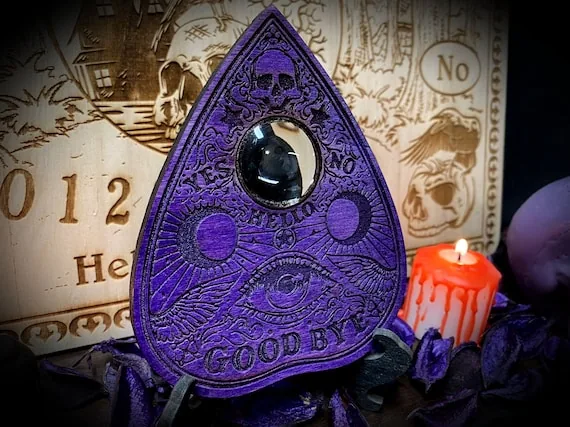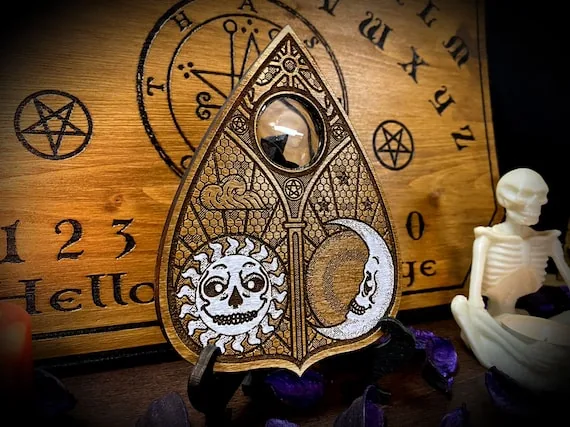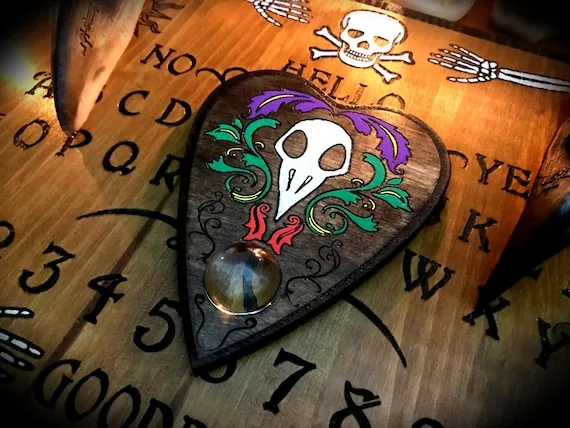
A wooden Ouija board is not born when the laser starts. By that point, most of the important decisions have already been made.
It starts with an idea
Sometimes the beginning is a symbol. Sometimes it is a historical mood, a particular occult language, a colour, a customer request, or simply an image that appears in my head and refuses to leave.
The first task is to decide what the board should feel like before deciding what it should look like. Severe? Victorian? Pagan? Minimal? Ornate? A board covered in symbols can still feel empty if those symbols have no visual relationship with one another.
Choosing the wood
Wood is never a completely neutral surface. Grain, tone and small natural differences change the finished piece. Before engraving, the board needs to be prepared so the design can sit cleanly on the surface and the object can survive being handled rather than merely photographed.
The same applies to the planchette. It is not an accessory added at the end; visually and physically it belongs to the board.
I prefer the signs of handmade work to remain visible. The aim is precision without making the object feel anonymous.
From drawing to laser engraving
The alphabet, numbers, YES and NO, the central imagery and the decorative border all have to share the same visual language. Once the composition works, the artwork is prepared for laser engraving.
Laser engraving gives me repeatable precision, but it is only one stage of the process. The object still has to be handled, checked and finished by hand. Different woods and designs react differently; every new model earns its final version through testing.
Finish, planchette and the last details
After engraving, the board is cleaned and finished according to the intended look. Edges matter. Surface feel matters. Contrast matters. Then the planchette is matched to the board, and the piece is checked as a complete object rather than as two separate parts.
This is the stage where a small change can make the difference between “finished” and “ready.” Those are not always the same thing.
When the board becomes yours
Personalization is one of my favourite parts of the work. A name, a phrase, a symbol, a different graphic element or a completely new direction can turn an existing design into something much more personal.
Some custom projects begin with a very precise request. Others begin with only a sentence: “I have an idea.” Those are often the interesting ones.
See the boards that have made it out of my head.
Explore the current Ouija boards and related creations available from The Little Sorcerer.
Explore Ouija Boards