The Wheel of the Year is beautiful because it refuses to pretend that time is a straight road. It turns, returns and asks us to notice what has changed since the last time we stood in the same season.
Thinking in circles
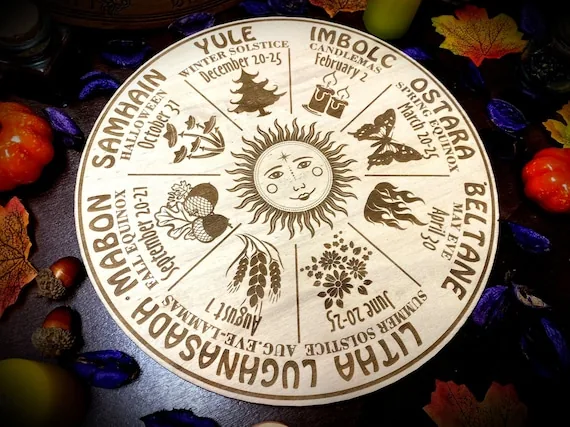
Modern pagan traditions often use the Wheel of the Year as a way of organising eight seasonal festivals across the solar year. It joins solstices and equinoxes with four additional seasonal celebrations, creating a symbolic map of growth, fullness, decline, darkness and return.
Not every practitioner observes the wheel in exactly the same way, and not every tradition gives identical meanings to each festival. That flexibility is part of what makes the wheel useful as a personal practice.
Eight seasonal stations
The names are only the beginning. Climate, geography and personal experience matter. The same date feels different in Sardinia, northern Europe or the southern hemisphere. A living seasonal practice pays attention to the actual world outside the window rather than only to a diagram.
Making the wheel personal
You can use the Wheel of the Year as a ritual calendar, a journaling structure, an altar reference or simply as an invitation to observe the seasons more carefully.
One useful approach is to choose a small question for each point on the wheel. What is beginning? What needs tending? What has reached fullness? What can be harvested? What is ready to be released? What deserves rest?
You do not need an elaborate ritual eight times a year. A candle, a page in a journal, a walk, a seasonal meal or a few minutes of attention can be enough.
Why make the wheel a physical object?
I like making Wheels of the Year in wood because the circular form becomes something you can actually place in a room. It can sit on an altar, hang on a wall or become a visual anchor for a practice that otherwise exists mainly as dates in a calendar.
The material also changes with time. Wood darkens, marks appear, and the object becomes part of the seasons it is meant to represent.
And then the year returns
Eventually the festival you marked last year comes back. The symbols are familiar, but you are not exactly the same person who encountered them before.
That, to me, is the quiet power of the wheel. It gives us a structure for noticing change without pretending that every change must be dramatic.
Bring the seasons into the room.
Explore the current Wheels of the Year, altar plates and seasonal creations in the workshop.
Explore Wheels & Altar Plates